Showing posts with label budget. Show all posts

Sunday, August 29, 2010

Lessons Learned, Money Saved


Here's a bit of money-saving inspiration from "The Simple Dollar:"


This is a fun list. I especially like the items that go "_________ isn't nearly as scary as it sounds." It's so true. A lot of times we spend money to get out of things that really aren't that bad.

What have I learned from trying to save money? Here are a few things, in random order:

1. It's fun to create money strategies and then watch our progress.
2. You realize a lot of things are completely unnecessary after you've put off buying them for a while.
3. Some things cost more to upgrade than others. For example, we could rent a tiny house (here in the bay area), or we could stick with our apartment and stay at the Four Seasons twice a month for the same total cost.
4. I love beans.
5. Buying things isn't as much fun as doing things. See this post.


Sunday, May 2, 2010

Alterations to the Clothing Budget


Cutting back on the clothing budget can be really hard. Somehow it feels more personal than other things. But, it is often necessary, and it can make a huge difference in our overall spending. Here are a few strategies to help. Choose the ones that work for you.

1. Keep careful track of how much you spend on clothes each month. Sometimes just seeing the numbers will help you come back to reality.

2. Learn to be thrifty. Check out this article from the April Ensign. Jane McBride Choate gives great practical advice for getting everyone dressed while staying on budget.

3. Make some new rules. If you are too often finding items that are irresistible, maybe it's time to set some guidelines. The easiest rule to make this: if you don't have money left in the clothing budget you can't buy it, no matter how cute it is. You can add in some more creative rules, though. Use your imagination. My cousin-in-law used to keep herself in check by selecting one color every year. If an item wasn't available in that color, she couldn't buy it. My mom's strategy was to make me think about it for a while. If it's still irresistible tomorrow, you can always come back. Or try this: you can't buy anything new until you've worn everything in your closet at least twice!

4. Buy clothes that fit and flatter. Usually when I throw clothes out without wearing them much, it is because they never quite fit right or they emphasize my figure in awkward ways. It doesn't matter how trendy it is; only buy if it looks great on you.

5. Speaking of trends... If you don't love it, skip it.

6. Shop with cash. Somehow money is more real when you hold it in your hands. A few months ago, Jeremy and I gave each other a sorely needed clothing bonus-- in cash. It was great. I always knew how much money I had left, and I managed to make it last.

7. Learn to love the thrift store. With a little patience you can find some great stuff here (I promise). You may not find it this time, though... Thrift stores also offer a dose of perspective: You can see what things look like after they have been washed a few times. And you won't be overcome by the chic atmosphere. It's all about you and the clothes. Do they fit right? Do you enjoy wearing them? Okay.

8. Avoid marital tension. At our house, we do this by making clothing come out of our personal allowance. Electronics also come out of our allowance. I buy clothes; Jeremy buys computers. All is budgetary bliss.

9. Don't shop for recreation. (This bit of advice comes from my family finance professor, Alena Johnson ). If you have enough clothes, and you're bored, you can always make someone cookies.

p.s. I love cookies

10. Be you. Remember that old Mormonad? "Be you're own kind of beautiful." If not, here's a link. We really can't be everything. Enjoy the beauty and talents of others; be beautiful and talented yourself; but don't be the same.

Saturday, March 20, 2010

Finding a Happy Money Medium


I just read a great post titled The Balance Between Splurger and Miser. It's from one of our favorite sites, Get Rich Slowly. April Dykman writes about how she has struggled with money, first spending money she didn't have, and then later almost refusing to spend at all, even though she had money to spare. Now she's finding a happy medium. Everyone should read it.

Dykman's post is a reminder that money is not just something to keep or lose. It is a way of expressing our priorities. If we truly value something, maybe we should spend more on it. (And we can always cut back on things we care less about.)

At the end of her post, she makes a list of things that are important to her, things that are worth a little extra.

My list would include eating healthy food, having supplies to build and create, helping people, and visiting family, among others.

What would you include? Does your spending reflect the things that are most important to you?

Monday, March 1, 2010

Over Budget


Okay, it's time for a confession. I am currently $64 over on my allowance. I am in debt to my own budget. Ick.

The good news is, I'm making progress. I have been trying to dig myself out since January, when it was much worse (and the allowance debt rolls over every month, no freebies).

I'm going to make it out, though. I am determined. No new German bakeware this month :-).

Friday, February 19, 2010

Who is Responsible for the Family Budget?

For the greatest happiness and productivity in life, both husband and wife are needed. Their efforts interlock and are complementary. Each has individual traits that best fit the role the Lord has defined for happiness as a man or woman. When used as the Lord intends, those capacities allow a married couple to think, act, and rejoice as one[.]

Richard G. Scott, The Joy of Living the Great Plan of Happiness

In the family where I grew up, my father did the finances. In Jeremy's family, his mother did them. So, naturally, when we got married each of us hoped the other would do them.

It took us a long time to figure out who would be responsible for our money.

In the meantime, we had a budget, but we didn't follow it well or keep detailed records. Bills got paid on time, usually, but we spent more and saved less than we should have.

Fortunately, Jeremy stepped up and decided we needed to put together a better system. Every family is different, but here is what works for us:

1. Jeremy set up budgeting software and makes sure it is working correctly.

2. I go through our expenses every week online and label them with the proper budget category.

3. Jeremy pays online bills.

4. I pay bills that require writing a check.

5. Together, we discuss the budget and make changes as needed.

6. Jeremy files taxes.

7. I deposit most checks.

8. Jeremy manages our investments and keeps me informed.

9. Both of us are responsible for staying within budget.

Thursday, February 18, 2010

Necessary Skills

This month's visiting teaching message is titled
"Managing Resources Wisely and Staying Out of Debt."

Each of the church leaders quoted in the message talks about skills we need to take care of our families and avoid debt, among these are cooking, learning "emotional resiliency," saving money, and having faith.

Trying Not to Spend

My cousin (who is a lot smarter than me) once told me that she used to think she would not have to budget as long as she didn't spend very much. She had since discovered that a budget was a necessity.

It took me a few years to figure out she was right.

Why doesn't the try-not-to-spend-too-much method work? I think there are a couple of reasons. First, without a budget we have no reason to prioritize. It is easier for us to justify purchases as something we need or deserve, and we have nothing to curtail us but a vague sense that we have spent too much. Second, we forget. I never feel like I have spent much, but the record we keep of our expenses tells me otherwise. It's a good reminder to count the extras I have and be grateful.

Monday, January 18, 2010

Grocery Buying Thought # 4: Use the Step-Down Method

In the spirit of being overwhelmed...

Looking back over my posts about grocery buying, I realize some of it sounds a little extreme. Budgeting should not stress you out. If you hate cooking, it probably isn't worth it to make everything from scratch.

So, what can you do?


Use the step-down method! (See my original post about it. I love this.) You don't have to go from buying all the finest groceries to all the cheapest. You just have to take a few steps down, and keep doing it until you are within budget.

What do you really care about?

Prioritize. If you love gourmet butter, buy it. But that might mean you need to buy store-brand on a few other items. Keep the things you really want, and step down on the things that don't make as much difference. You'll hardly notice (but your budget will).

Improve your plan. Have to have deluxe frozen pizza? You could decide to buy only when it's half price. Or you could start buying it half as often. That counts as stepping down too.

See, we really don't have to do everything. Life is good.

Tuesday, November 10, 2009

Waste Not!

Waste not is one of the most important principles in saving money. It is also one of the hardest for me to follow. Sometimes I forget about a container of leftovers until it is too late. Sometimes half of the food I give my toddler at mealtime ends up on the floor, and sometimes I buy food without a good plan for using it.

It's something I'm working on.

The article Study Analyzes Food Waste in Britain, is a wake-up call. It is amazing how much food we throw away, and the damage goes far beyond our food budget.

Monday, August 17, 2009

We Can Afford It

These two lessons are the essence of provident living. When faced with the choice to buy, consume, or engage in worldly things and activities, we all need to learn to say to one another, “We can’t afford it, even though we want it!” or “We can afford it, but we don’t need it—and we really don’t even want it!”

Elder Hales gave a very good talk during the previous General Conference about being provident providers. He gave as examples two stories about times he wanted to buy gifts for his wife, but she turned them down. Each time, she had a different reason. When she gave her first reason, I just nodded, thinking that of course she was right to turn down a gift when they couldn't afford it.

It was the second gift that struck me - she asked him if he was buying the gift for her or for himself. He wasn't buying her a power tool, golf clubs or another type of gift that I think of when I consider the type of gift you are really giving to yourself, not someone else (like when I my little brothers decided to buy a computer game they really wanted "for the family" for Christmas - they were the only ones to play it, as you might guess). No, in this case the gift was one that was definitely for her - a very nice coat. What she meant then was probably that he was buying it to make himself seem like a good provider, and to show off his wife and his money to the world. It didn't matter that they could afford it - he was buying the gift for the wrong reasons.

I realized that I do this myself. Sometimes, when I buy something for my wife, I justify going over the budget because it's for her. Looking back though, I realize that I often had thoughts about how this would impress my wife's friends or ward members, and how she'd have to appreciate me being willing to go over the budget for her gifts! In fact, I realize now that I occasionally felt a little cheated when my wife stayed within the budget on my own gifts! I'm going to have to work on repenting, and when I want to spend a little extra on my wife, I'm going to just have to save money somewhere else first. Besides, I'm the one who set the budget numbers - I have no excuse to go over.

Saturday, July 25, 2009

Grocery Buying Thought #1: Staples


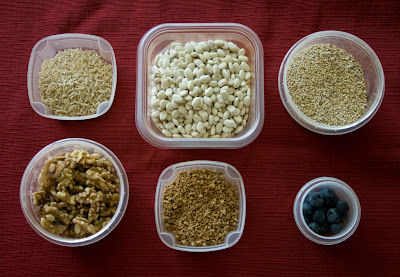
One way to reduce the amount you spend on groceries is to figure out which foods are staples in your family's diet and make adjustments. For example, convincing your family to drink water instead of soda will save a lot of money, and it will make everyone healthier.

For my family, throwing out the granola bars made a significant difference. At first it made sense to me to buy low-sugar granola bars in bulk. They were relatively healthy and we could eat them on the run. The problem was, I liked them so much, I ate them all the time. Eventually, I realized I ought to be eating whole grain bread or rice, nuts, and fruit instead.

The great thing is, any one of these things cost less per ounce than the bars. The grains--which made up the bulk of the bars anyway--cost much less. I stopped buying the bars and, when they were no longer an option, I started eating healthier replacements. I save money every month, just by cutting them out.

Here are a few other adjustments we are working on:

-more beans and lentils, less meat
-whole grain bread and rice as staples (good, cheap, solid, healthy calories)
-more seasonal fruits
-only very inexpensive, healthy cereals
-more whole vegetable, fewer prepared veggies
-no more frozen pizza (I have to admit, sometimes I get nostalgic about these)
-if I am desperate for cookies, then I have to make them myself

Monday, July 13, 2009

Comparing a State's Finances to Personal Finances

Mint.com has a great article comparing the state budget crisis in California to our own personal finances:

Understanding the California Budget Crisis

It's often possible to learn valuable lessons about our personal lives from large events involving many people. The pride cycle of the Book of Mormon is certainly applicable in our own lives, and the scattering and gathering of Israel can be a powerful metaphor for repentance. Similarly, we can learn important lessons about our own finances from the financial failings of large institutions, states or countries...

And California has definitely failed.

Wednesday, July 1, 2009

The Step-Down Method


The key to spending less than we earn is simple—it is called discipline. Whether early in life or late, we must all eventually learn to discipline ourselves, our appetites, and our economic desires. How blessed is he who learns to spend less than he earns and puts something away for a rainy day.

N. Eldon Tanner, Constancy Amid Change

When I was at Utah State, I took an excellent family finance class taught by Alena Johnson. In addition to teaching classes, she worked in a financial counseling center on campus helping people who had found themselves in difficult financial situations. One of the gems I picked up from that class was something Alena called the "step-down method." Simple and adaptable, it is the best method I have found for reducing our family's expenditures.

Here is how it works: In any given situation, you have a variety of options, and some cost more than others. The example used in class was waffles.

Restaurant waffles: a few dollars
Frozen waffles: about a dollar
Waffles from a mix: less
Waffles from scratch: pennies

Sometimes people think that in order to cut back, they have to drop from expensive end of the scale to the cheapest end. This can be kind of depressing. The point of the step-down method is that, wherever you are, you take a step down. If you are eating waffles at a restaurant every Saturday morning, you will save a lot of money by eating frozen waffles at home. If you make waffles from a mix and you still need to cut back, you can start making them from scratch.

You can apply this principle just about anywhere. How do you watch movies? Where and how often do you eat out? What makes for a good family vacation? Where do you buy your clothes? Take a step down in several areas and you will find more room in your budget. You may also find that there are some areas where you are willing to pay for the nicer option, and some areas where spending more hardly made a difference.

Saturday, June 27, 2009

Engineered Food


"...all wholesome herbs God hath ordained for the constitution, nature, and use of man— Every herb in the season thereof, and every fruit in the season thereof; all these to be used with prudence and thanksgiving." Doctrine and Covenants 89:10-11

When we finally got serious about staying within our food budget, I found I needed to stop buying some of the snack foods we ate on a regular basis. It has turned out to be a good thing. While our diet is far from perfect, we eat fewer "easy" calories and we are more hungry for real, nutritious food.

Here is an interesting article I read from the New York Times that talks about the engineering that goes into some of the foods we buy. There is a reason these foods taste so good!... and are not good for us.

Well: How the Food Makers Captured Our Brains

Friday, June 12, 2009

Priorities

Do not spend money for that which is of no worth... 2 Nephi 9:51

Artyom was an Armenian man, approaching middle age, who lived in southern Russia with six or seven other men. They had come to Russia to work and send money home to their families, because there were no jobs in Armenia.

When we met him to speak about the Gospel of Jesus Christ, he was at home from his job in construction, and relaxing. To relax, he smoked cigarettes and drank. Now I knew something about cigarettes - with all of the second-hand cigarette smoke in Russia, I figure I became an expert on brands available in Russia. I always feared the cheap Russian brands, especially the unfiltered ones - and I always felt a little bit relieved when someone pulled out a pack of Marlboros or Parliament. His alcohol was also relatively expensive.

His apartment, on the other hand, was certainly not an oasis - eight construction workers in about 700 square feet.

Artyom explained to us that he was very rarely able to go back to Armenia to see his family, since he had to save as much money as he could to send back to them.

"More important to me than anything else are my family, and my health." Said Artyom.

I'm not sure Artyom realized at the time how much better off both his family and his health would be without the expensive liquor and cigarettes. But as I've thought about it, we all have similar habits that are very damaging to our goals and priorities.

For any budget, these are the best expenses to drop first. Go through your expenses, and try to find any items similar to these:
  • Excessive amounts of food that is unhealthy and expensive - fast food, soda and other unhealthy snacks
  • Expensive television packages that just add more excuses not to interact together as a family
  • Purchases of inappropriate movies, books, music or other media
  • Anything contrary to the Word of Wisdom, of course
  • Overly expensive clothing
These are the types of items where spending less will actually lead to a better standard of living - and should thus probably be the first things to go when building a budget.

The way money is spent is a good indicator of where one's real priorities are.


Tuesday, May 26, 2009

Giving Yourself an Allowance

Jeremy jokes that every time I mention my allowance in public, he wants to sink into his shoes. It makes him sound like he's really keeping me in check-- the little wife whose husband doles out ten dollars at the beginning of the month, expecting her to cover all the household expenses while he spends whatever he wants. He finds himself wanting to say that it's not as bad as it sounds: he has an allowance too, it's something we both agreed on, I helped determine the amount, etc. etc. Unfortunately, he doesn't often get to explain himself. And usually when I say "I'd love to buy this, but I'm all out of allowance this month," people just have to speculate.

I don't mind making Jeremy squirm a little. It's good for a man. But giving yourself a personal allowance each month has a lot of other benefits as well.

Number one benefit-- freedom. You read that right. While it may not be a huge amount, I have a certain number of dollars every month that I don't have to answer to anyone about. I can spend it all on candy if I want... or maybe one of those elegant German bread pans I was reading about.

Second benefit-- it's easier for me to recognize a good deal now. Have you ever bought a shirt on sale, brought it home, and realized after wearing it once or twice that it you don't even like it? When I am limited by a dollar amount, instead of thinking what a bargain, I should buy two, I think well, it's 75% off, but is it really worth ten dollars of my allowance? You can spend all your money on great bargains and come away with all sorts of things you hardly use and end up throwing out.

Third benefit-- exercise in creativity. I am always coming up with things that I need to buy: new furniture, gadgets, hair products. Anytime there is a problem to be solved, it seems there is a product to help you out. Fortunately, as I have discovered, most of the time there is a way to solve the problem without spending money. Finding the solution takes work and brain power, and it is immensely satisfying.

Fourth benefit-- marital bliss, at least a little bit of it. I don't have to worry about my husband's electronics-buying habits. As long as it's in his allowance, he can get all the computer accessories he wants. In return, I don't have to worry about him rolling his eyes when I come home with an elegant German bread pan.

Fifth benefit-- the obvious. Allowances help us keep our spending in check. For us, this means that someday we can get a house, with some good cupboard space for my European bakeware.

Saturday, April 18, 2009

Budgeting Software

When you can measure what you are speaking about, and express it in numbers, you know something about it; but when you cannot measure it, when you cannot express it in numbers, your knowledge of it is of a meager and unsatisfactory kind; it may be the beginning of knowledge, but you have scarcely, in your thoughts, advanced it to the stage of science.

Sir William Thompson, Lord Kelvin (1824-1907) Source

For a few years, I've attempted to keep a budget. My initial attempt involved a spreadsheet that I updated every week with our expenses. This worked well until I forgot for a few weeks, and had a difficult time remembering what each of my expenses were for.
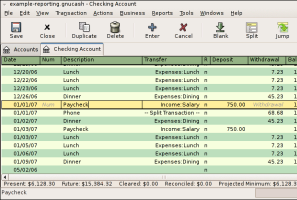
GnuCash


I moved on to a powerful program called GnuCash. This free, open-source software has a very complete set of features around managing various accounts and budgeting. It is powerful enough for small businesses.

It suffers, however, from some of the standard problems of open source software - an unintuitive, sometimes buggy design, and a few missing, vital, features. If GnuCash could automatically download the information from my financial institutions, and correctly handle cash transfers between them without a lot of work, I'd still be using it. As it was, I had to go to each financial website, download their data in a Quicken-compatible format, and import it into GnuCash. Very laborious, and it then duplicated any transaction that occurred between two accounts.

I find this software very promising though, and will try it out again once they've taken care of a few of these basic issues. I would definitely recommend it for a small business however, where transactions would need to be entered manually anyway. It's reporting, budgeting and graphing capabilities are excellent.

Quicken Online


About a year ago, I began using Quicken Online. It is basically a much lighter version of their desktop software. It has a simple, very intuitive interface, and can handle basic budgeting tasks well. It can automatically download financial information for every account that I've tried, and does an excellent job of automatic categorization.

I can set up a budget, and view my spending trends. It only provides limited graphing of recent spending, but it is usually sufficient.

This service recently became free, and would be especially useful for anyone who wants to be able to access the same budget information anywhere - there is even a mobile version.

If being able to access the information anywhere is not as important, buying the desktop version of Quicken might make more sense - it is a very mature, powerful piece of software.

For simple, low maintenance budgeting though, I can definitely recommend Quicken Online, with a few warnings. Intuit (the makers of Quicken) seems to have much more experience with desktop software, and they have somewhat frequent bugs in the Quicken Online software. This is a bit surprising though, given that they also make Turbo Tax, the online version of which is very stable. So, be prepared to have problems accessing your information for a few hours at a time every once in a while.
Mint.com


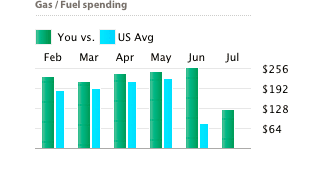
Mint.com has been around for quite a while, and has an impressive set of features. I tried it out during one of Quicken Online's downtimes. Here is my quick comparison:

Budgeting: Mint has far more flexibility, and can compare what you spend in different categories to average spending in different parts of the US. Very handy. As is usual, however, the user interface for this feature is definitely better on Quicken's site.

Account management: Mint seems to be more powerful at importing information from financial institutions, but requires that you store answers to any secondary questions from your financial institution (ie, mother's maiden name) on the site. Quicken allows you to just enter it when needed, which is at least slightly better from a security perspective.

Interface and Usability: Quicken Online is definitely better designed as far as the user interface. Mint.com's many features are a bit weird to navigate and poorly organized.

Stability: In my experience, Mint has fewer bugs than Quicken Online, and less downtime.

Other: Quicken is almost certainly losing money on Quicken Online. Mint.com, on the other hand, is working hard to advertise financial services on their site. They recommend bank accounts, credit cards and more based on your spending habits. I actually like this feature much of the time, since it attempts to recommend them based on how much money it would save. It's nice to see a list of checking accounts that you could use instead to be earning more interest, or which cash back credit card best fits your spending habits.

So, which should you use?

Quicken Online's variety of bugs and frequent downtimes definitely make me lean towards Mint.com in general for flexible web-based financial software.

If you don't mind not being able to access your information anywhere, and are willing to pay some money for the service, use Quicken or a similar program. If you have a Mac, however, be warned that the Mac version apparently has fewer features than the Windows version, while retaining the hefty price tag (and will soon have a different name).

If you don't mind a little bit of extra work and love open source software, you might give GnuCash a try. If you don't like the way a feature works, you could always fix it yourself anyway. It's also a good way to get some geek street cred.