Showing posts with label education. Show all posts

Saturday, March 20, 2010

Finding a Happy Money Medium


I just read a great post titled The Balance Between Splurger and Miser. It's from one of our favorite sites, Get Rich Slowly. April Dykman writes about how she has struggled with money, first spending money she didn't have, and then later almost refusing to spend at all, even though she had money to spare. Now she's finding a happy medium. Everyone should read it.

Dykman's post is a reminder that money is not just something to keep or lose. It is a way of expressing our priorities. If we truly value something, maybe we should spend more on it. (And we can always cut back on things we care less about.)

At the end of her post, she makes a list of things that are important to her, things that are worth a little extra.

My list would include eating healthy food, having supplies to build and create, helping people, and visiting family, among others.

What would you include? Does your spending reflect the things that are most important to you?

Sunday, July 12, 2009

Competitive Times

You are moving into the most competitive age the world has ever known. All around you is competition. You need all the education you can get. Sacrifice a car; sacrifice anything that is needed to be sacrificed to qualify yourselves to do the work of the world. That world will in large measure pay you what it thinks you are worth, and your worth will increase as you gain education and proficiency in your chosen field.

You belong to a church that teaches the importance of education. You have a mandate from the Lord to educate your minds and your hearts and your hands.

Gordon B. Hinckley, A Prophet's Counsel and Prayer for Youth.

Our state has hit 11.5% unemployment. The competition that President Hinckley spoke of is far more intense now than usual, making education even more important.

Besides, a college or vocational school is a good place to sit out a recession - once one's studies are done, the job market has usually recovered.

Friday, July 10, 2009

Skip the 10-Year Plan

For which of you, intending to build a tower, sitteth not down first, and counteth the cost, whether he have sufficient to finish it?
Luke 14:28

Now that you're convinced to go to college, it's not enough just to show up for a few years at the college campus.

I have a friend who, as is common among college students, is on the "Ten-Year Plan". This is the plan where a student changes their major (or gets D's) so many times, that it takes far more than four years to graduate. As he finally, hopefully, approaches graduation (it will only have actually been six or seven years), I asked him what he would do differently.

"I wouldn't change my major."

As it turned out, his final major is identical to his original major. A few times throughout his college work, he decided he didn't like his major, and changed to a different one - sometimes a very different major. As one major proved difficult, he moved to an easier one, but then realized he'd have no good career options, so he moved to a more lucrative easy one. He then discovered that he hated it - and moved back to an interesting difficult major.

This reminded me of a decision that I made when I first started college, that turned out very well. I had about six different majors that I was considering. After speaking to people from the different departments, I still couldn't decide which was best, so I picked a major based on a few criteria:
  1. It required many classes that were also required by other majors I was interested in.
  2. It could result in a good career, with which I could support a family, with just a Bachelor's degree.
  3. It could lead to a variety of Master's Degrees.
  4. It sounded like it would be interesting, and challenging.
I then decided to finish that degree no matter what (well, almost no matter what). Then, if I had decided by then that I hated the degree, I would go on to get a Master's Degree in something I actually liked. Then, I could take as long as I wanted on the Master's Degree - if it didn't work out, at least I'd have a Bachelor's degree and be able to find a good job if I needed it.

Things did not, as usual, turn out quite as expected. Once I finished the degree that I chose, I was offered a very good job, and am now just working on a Master's Degree part-time. Many of my friends, though, are still in school and having difficulty supporting their families, since they have taken so long to graduate. I have a lot of freedom, thanks to having finished what I started.

I certainly made (and will probably continue to make) various mistakes in my educational choices - but I'll write about those later.


Friday, June 26, 2009

Another reason to go to college

Here are some articles that have caught my interest lately.

It's a big risk to skip college, even if you think you have a great, guaranteed job opportunity:
As Plants Close, Teenagers Focus More on College

Some careers are rougher on families than others. Take this into account when deciding on a career path:
Financial Careers Come at a Cost to Families

Highly skilled workers are in demand even in recessions:
Despite Recession, High Demand for Skilled Labor

Saturday, June 20, 2009

Focus on Family Finances - Education

The June, 2009 issue of the Ensign has some great articles on family finances and preparedness. One article brought up one of my favorite ideas about handling unemployment, right at the beginning.


In Focus on Family Finances, Allie Schulte from Welfare Services writes about a family that had become unemployed. They turned this into an opportunity to go back to college and finish the Bachelor's degrees they'd started. Because of that, their job options became far better than they would have without the extra education, and their now on solid financial footing.


An education is one of the best and least risky investments one can make while working towards self-sufficiency, especially if one has recently become unemployed. Consider:
  1. An education pays off. Check out this US Census report on financial benefits of education.
  2. When a recruiter sees a six month period (corresponding to six months of unemployment) missing from a resume, he or she is concerned. Replace that time with work towards more education however, and it can only make a resume look better.
  3. If you've been laid off, maybe the work you were doing wasn't a great fit - maybe it's time to learn some new skills, or branch out into an entirely different area.
  4. By taking more classes now, you'll have a more up-to-date education than others working in the field, and more experience than many of those just graduating.
  5. Networking to find employment is more effective while taking classes than while surfing job posting websites.
  6. Prophets of the Church have advised us to get as much education as possible: Seek Learning, by President Hinckley
There are many different flexible programs available. I actually take part-time classes at the local university, just to make sure that my skills stay up-to-date and that I keep my career moving in the direction that I want. If I get laid off, I'll just switch to being a full-time student again, and work towards an advanced degree.

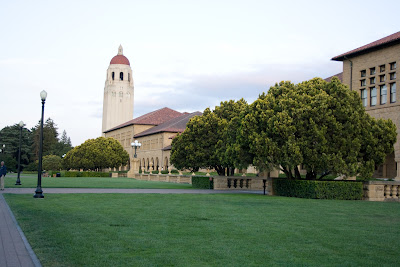
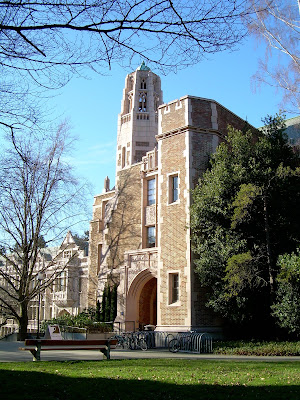
(Stanford University and the University of Washington are pictured above)