Showing posts with label step-down method. Show all posts

Monday, January 18, 2010

Grocery Buying Thought # 4: Use the Step-Down Method

In the spirit of being overwhelmed...

Looking back over my posts about grocery buying, I realize some of it sounds a little extreme. Budgeting should not stress you out. If you hate cooking, it probably isn't worth it to make everything from scratch.

So, what can you do?


Use the step-down method! (See my original post about it. I love this.) You don't have to go from buying all the finest groceries to all the cheapest. You just have to take a few steps down, and keep doing it until you are within budget.

What do you really care about?

Prioritize. If you love gourmet butter, buy it. But that might mean you need to buy store-brand on a few other items. Keep the things you really want, and step down on the things that don't make as much difference. You'll hardly notice (but your budget will).

Improve your plan. Have to have deluxe frozen pizza? You could decide to buy only when it's half price. Or you could start buying it half as often. That counts as stepping down too.

See, we really don't have to do everything. Life is good.

Thursday, November 12, 2009

The Step-Down Method: Is living within your means enough?

I have a friend who always lives within his means. However much money he has, he spends just a little bit less than that. He's certainly doing better than those who drown themselves in debt.

It is almost funny to see how quickly he adapts his lifestyle to his current income. He's single, and incredibly talented. When he's employed, he usually makes quite a bit of money. When this happens, he buys all sorts of nice things for himself and eats out a lot. When he's unemployed, he still, somehow, manages to survive (I assume he does some good food storage).

This reminds me of what happened when I got my first full-time, professional position. We immediately bought a bunch of nice things - because we had money. It took us a few months to realize how little money we were actually saving, even though we were making far more money than we had before. Decreasing our spending by a mere 10% resulted in a substantial surplus that we could put into savings.

Though the step-down method is usually targeted at those with debt, it can be especially useful for those who are just barely living within their means. The seven years of plenty are often followed by seven years of famine.

Friday, July 17, 2009

How Often Should Computers be Upgraded?

When I was a kid, I figured that everyone ought to upgrade their computer at least every year or two. I continued to think that until recently, when I was shopping around for a new computer for our home. I realized that I wouldn't actually get that much of a noticeable increase in capability by buying a new machine. I'd get a number of "nice" things, but nothing that was really necessary. So, instead of buying a new computer, I decided to address the specific issues that I had:
  1. I had difficulty running some heavy duty mathematical software, so I doubled the RAM in the computer from 1 GB to 2 GB. This cost $30. It works fine now.
  2. Netflix streamed videos were a bit choppy (because of the new SilverLight player). I discovered that Boxee can play Netflix videos better than a web browser, and the choppiness problems went away.
  3. We were a little bit low on hard drive space. I moved most of our media files to an external drive.
Now the three-year-old laptop does everything I need it to do, and it only cost me $30 plus a little bit of work. Now I can wait another year or so before buying a new computer!

If you're deciding whether to buy a new computer or upgrade your current one, here are my recommendations:
  1. If you can upgrade your RAM to at least 1 GB, do that. If you've been running Windows XP or Mac OS X with only 512 MB, you'll be surprised at how much better it works (if you're running Linux, you don't need this very basic post about computers). Make sure to add the correct RAM for your computer (check out NewEgg).
  2. If your hard drive is more than 70% full, buy a larger one (perhaps external).
  3. If your computer can't be upgraded to 1 GB RAM, and you want to use it for modern software and web applications, you're probably best off replacing it soon.
As a last note, from a productivity standpoint, it can be beneficial to spend almost as much on the monitor as on the computer itself. Studies, such as this one from the University of Utah, seem to show that larger monitors result in better productivity. Currently, a 24-inch monitor seems to be the offer the best balance between affordability and size - or, you could always hook up multiple monitors...

Sunday, July 5, 2009

How Many Cars do You Need?


OK, those of you who don't own a car, go pat yourselves on the back and read a different article.
For the rest of us, imagine with me. Now, imagine owning one less car than you currently do.

We own one car, and it was built in 1995. It's been running really well lately. Even though we only have one car, we don't need it most of the time. Here's what we do:
  1. We walk everywhere that's within a couple of miles.
  2. I bike or jog to work (2 miles the short way, 5 miles the scenic way).
  3. I bike to school (5 miles).
  4. Julianne walks when she can do her grocery shopping close (she has to drive when going to Costco).
We don't end up needing the car very often, and have been putting fewer and fewer miles on it. Really though, it would be really easy to find a way justify having two cars in our situation (it's really easy to justify about anything if you want it badly enough), but we have saved a lot of money by only having one car.

When we were in Seattle, this was a bit harder - since it rained often enough that I couldn't always bike. So I got a bus pass instead for the rainy days.

OK, I know what some of you are thinking: "Jeremy you're cheating - you're supposed to imagine yourself with one less car."

Here goes:
  • We would still need a car to visit family a couple of times a year, as they live about 10 hours away. We could rent one for these occasions. This would actually be nice, since we could rent a small SUV to make it through the sometimes treacherous pass between here and there during the winter, instead of having to take a roundabout trip that adds 4 hours.
  • For occasions when we would need a car, we could use ZipCar!
  • Julianne can use the bike trailer when she needs to go shopping at Costco.
  • We can just plan better - half of our car usage is when we didn't plan well enough in advance.
  • Julianne would still need to find a bus or something - she often takes night courses at a college. Since they are night courses, it would be too late to bike back afterward.
  • There are lots of good public transit options around, so we'd probably be able to get wherever we needed just fine.
  • We'd save lots of money on repairs, car insurance etc.
We added everything up, looked at the probable costs for each option, and decided that not having a car probably wouldn't actually save us any cash - primarily just because of the high cost of renting a car to get back to see our families, which is where the car gets the majority of its miles anyway. In addition, ZipCar doesn't yet have any locations within four miles, which would make it difficult to use.

Add it up yourself - as we've decreased our own car usage, we've quickly discovered that we don't miss driving everywhere. And if you have two, three or four cars, the savings from getting rid of one or two of them can be substantial. There are many websites that can help to estimate the true cost of owning a vehicle.

Getting rid of an extra vehicle is one of the ideas suggested in this Ensign article for getting out of debt or avoiding bankruptcy: Before You Lose It All …

Wednesday, July 1, 2009

The Step-Down Method


The key to spending less than we earn is simple—it is called discipline. Whether early in life or late, we must all eventually learn to discipline ourselves, our appetites, and our economic desires. How blessed is he who learns to spend less than he earns and puts something away for a rainy day.

N. Eldon Tanner, Constancy Amid Change

When I was at Utah State, I took an excellent family finance class taught by Alena Johnson. In addition to teaching classes, she worked in a financial counseling center on campus helping people who had found themselves in difficult financial situations. One of the gems I picked up from that class was something Alena called the "step-down method." Simple and adaptable, it is the best method I have found for reducing our family's expenditures.

Here is how it works: In any given situation, you have a variety of options, and some cost more than others. The example used in class was waffles.

Restaurant waffles: a few dollars
Frozen waffles: about a dollar
Waffles from a mix: less
Waffles from scratch: pennies

Sometimes people think that in order to cut back, they have to drop from expensive end of the scale to the cheapest end. This can be kind of depressing. The point of the step-down method is that, wherever you are, you take a step down. If you are eating waffles at a restaurant every Saturday morning, you will save a lot of money by eating frozen waffles at home. If you make waffles from a mix and you still need to cut back, you can start making them from scratch.

You can apply this principle just about anywhere. How do you watch movies? Where and how often do you eat out? What makes for a good family vacation? Where do you buy your clothes? Take a step down in several areas and you will find more room in your budget. You may also find that there are some areas where you are willing to pay for the nicer option, and some areas where spending more hardly made a difference.

Wednesday, June 10, 2009

The Kid's Home Haircut Adventure


When Jeremy and I were first married, we invested in a trimmer set so I could give him haircuts at home. I had never cut hair before, and so I was fortunate to have an adventurous and forgiving husband.

Our investment has paid off. In the last few years, our $15 deluxe trimmer set has saved us hundreds of dollars, and I have learned a new skill. The trick is to take that skill and apply it to a more challenging situation...

After learning to cut Jeremy's hair, I figured I would be just fine cutting my kids' hair. I had no idea how hard it would be. My son hates anything touching his head. He gets so upset when I cut his hair that I have considered taking him to a specialty kids' salon. Two things have held me back, the price ($20 and up), and the fact that my son has a hard time with strangers. Luckily, things are getting better.

Today I cut my son's hair and there was plenty of whining, but no crying or screaming. I consider this a success. Kids' haircuts are not for the faint of heart, but here are a few things that helped us survive:

1. Giving warning. Before my son had his bath in the morning, I talked about cutting his hair. I also let him know that he could watch his favorite movie while we did it. By the time the bath was over, he was talking about getting his hair cut. He actually agreed to it.

2. Good setup. I put a chair with a booster seat strapped on sideways (so the back of the chair wouldn't block access to his head). I used a vinyl tablecloth as a drop cloth, and we were ready.

3. Ditch the trimmer. My son hates it. He does better sitting a little longer for a scissors-only cut. Some kids might do better with just trimmer, since it would be fast.

4. Distraction. Some kids are okay if they have something really neat to play with. Kids salons usually have cartoons. I put on a DVD.

5. Talk. My son needs lots of persuasion, reassurance, praise for sitting still a few moments, etc. Some kids might just want to know what's going on. I also let him know that if he moved around too much, I would pause the movie (I followed through on that a few times).

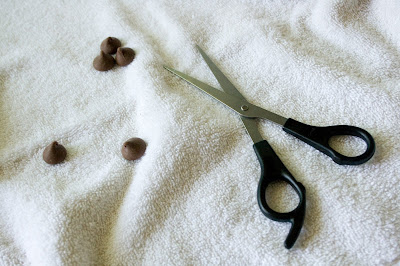
6. Bribes. I hate using candy as a bribe. Usually there is something you want to do for your kids anyway that works, like reading a book or going outside, but haircutting needs a very powerful bribe at my house. Today I pulled out the chocolate chips. They worked. Two big chocolate chips was enough for my son to let me trim above each ear. Ten or twelve chips total, and my son had short hair again.

So that's how we made it through a kid's home haircut. It takes some problem solving, but it really is doable.